
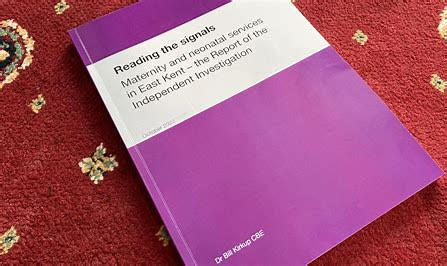
Sadly the failings / Neonatal deaths in EKHUFT Maternity persist. I can only feel sorriest for our mothers who must be scared witless, and then for the midwives and doctors that are tasked with improvements which until the day the service is truly patient lead and centred, and funded will never succeed. See Kirkup investigation report October 2022.
– go to page 226
REPORT TO BOARD OF DIRECTORS (BoD) Report title: Response to the Independent Stillbirth Review (post Quality and Safety Committee (Q&SC) comments) Meeting date: 1 October 2026 Board sponsor:
Sarah Hayes, Chief Nursing and Midwifery Officer (CNMO) Paper Authors: Head of Governance for Women’s Health, Managing Director of Women’s Children and Young People (WCYP), Director of Midwifery, Deputy Director of Midwifery, Maternity Improvement & Transformation Programme Manager
“The East Kent Hospitals University NHS Foundation Trust identified a cause for concern through our local monthly dashboard data. The data flagged a continued increase in the number of stillbirths from September 2025, rising above the Trust threshold, and as a result the Trust commissioned an Independent Stillbirth Review in October 2025. Its scope included all stillbirths at 34 weeks gestation or later, between September 2025 and March 2026. The table below demonstrates our data from September 2025 to August 2026 and our rising stillbirth numbers. This table is for all gestations. Image 1. 12mth rolling stillbirth rate The purpose of this report is to present the key findings, themes, risks and recommendations arising from the independent external review of 11 stillbirth cases at East Kent Hospitals University NHS Foundation Trust (EKHUFT). The report also provides an overview of the actions and assurance measures being taken by the Maternity Service in response to the review findings and to address 1/25 22 the sustained increase in the stillbirth rate observed since the review was commissioned, including the measures in place to strengthen safety, quality oversight and ongoing assurance. The independent review identified recurrent and systemic weaknesses in the management of high-risk pregnancy, fetal surveillance, maternity triage, escalation and organisational learning. Several of these themes have been identified previously through local and national reviews, suggesting that improvements have not yet been consistently embedded in frontline practice. Further stillbirths have occurred since the review period, reinforcing the need for sustained improvement, ongoing assurance and close Board oversight. The additional stillbirths that meet the Terms of Reference of the external review (34 weeks gestation or later) will also be considered by the review team with further assurance provided to the Board as to the findings. Further to consideration of this paper through Q&SC, high level feedback was received on 21 September 2026 following the NHS England (NHSE) Maternity and Neonatal Improvement Support Team Diagnostic Visit which took place on the 14 to the 17 September 2026. Feedback that directly relates to the external stillbirth review and the themes related to the review have been included in this paper for completeness and transparency. A full written report will be received in due course. Summary of key issues: We recognise the significant impact on families of knowing that had we acted differently, we may have altered the outcome for their baby. We sincerely apologise to these families for care that fell short of expected standards. The independent review identifies significant and recurrent patient safety, quality and governance concerns across maternity services, with evidence of systemic weaknesses rather than isolated failings”.